
Lignin in Ryegrass: Why It Matters for Digestibility, Intake and Animal Performance
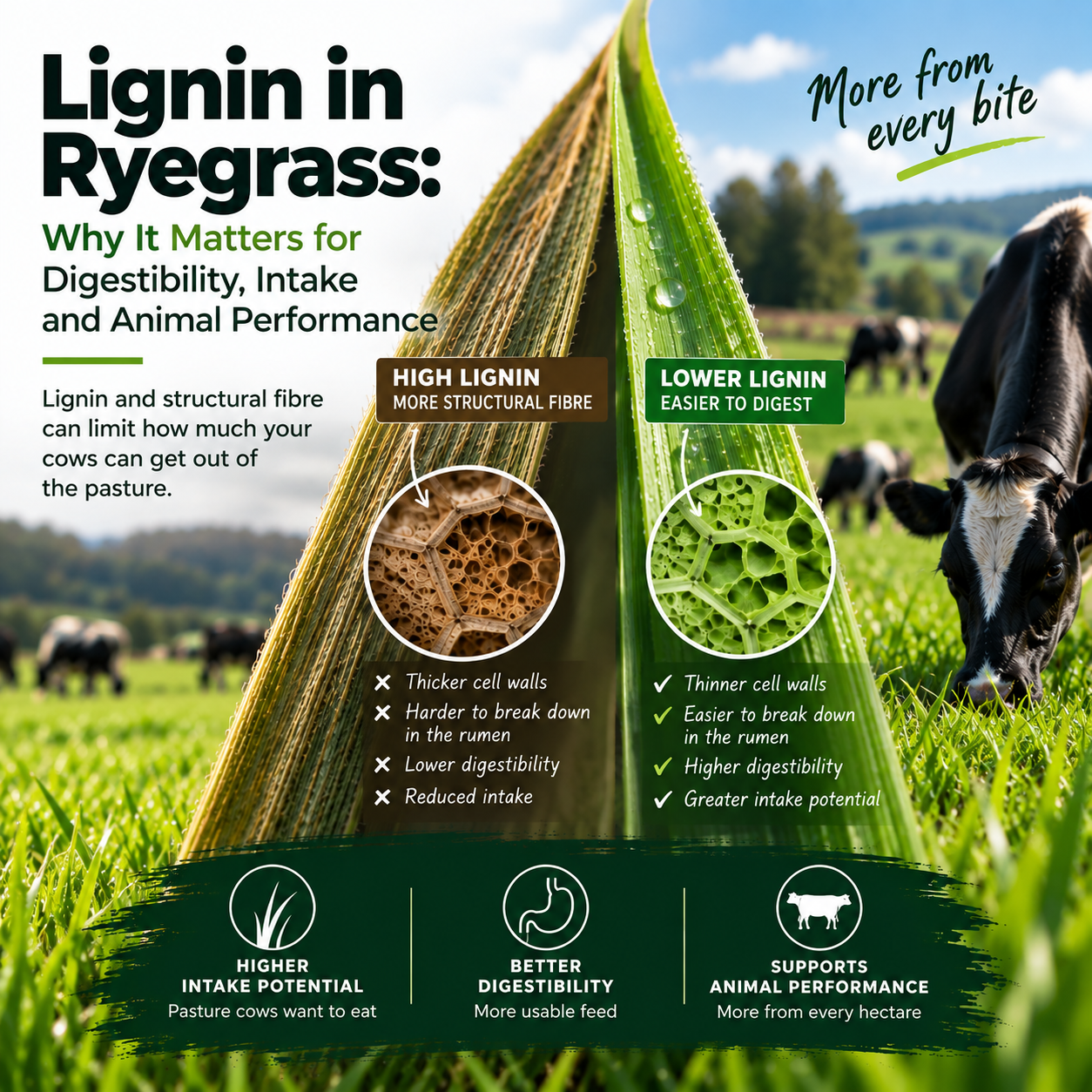
Two paddocks can grow the same kilograms of dry matter and still deliver different value to the animal.
The difference is not always visible above the fence. It can sit inside the ryegrass cell wall—in the amount and arrangement of structural fibre, and particularly in the effect lignin has on how much of that fibre rumen microbes can access.
That matters because permanent pasture is not only about how much grass you grow. It is about what your stock can get out of it.
The short version for farmers
Lignin is a natural, indigestible part of the ryegrass cell wall.
The plant needs lignin for strength and structure, but rumen microbes cannot digest it.
Lignin is closely associated with cellulose and hemicellulose and can restrict microbial access to these potentially digestible fibres.
As ryegrass becomes mature, stemmy or reproductive, lignification generally increases and feed quality declines.
Slower or less-complete fibre digestion can increase rumen fill and limit how much dry matter an animal can consume.
Lignin should never be judged alone. Read it alongside NDF, ADF, DOMD, metabolisable energy, sugars, maturity and pasture yield.
The fairest varietal comparisons use repeated samples taken at similar stages of regrowth and tested by the same laboratory method.
This is why Vernado looks beyond seed yield alone. Our ongoing ryegrass testing programme examines the feed quality of Stride, Algira and Supremacy perennial ryegrasses across the season, with the aim of understanding what the animal may be able to obtain from each kilogram grown.
See Vernado’s perennial ryegrasses and current forage-quality results
What is lignin in ryegrass?
Lignin is a complex structural material deposited within plant cell walls. It helps the ryegrass plant remain upright, strengthens stems and supports the movement of water through the plant.
From the plant’s point of view, lignin is essential. From the animal’s point of view, it presents a nutritional constraint.
Rumen microbes can ferment much of the cellulose and hemicellulose in a plant’s cell wall. They cannot digest lignin. Because lignin is closely bound into the cell-wall structure, it can also limit microbial access to the fibre around it.
Think of it less as feed and more as part of the plant’s reinforcing framework. The stronger and more restrictive that framework becomes, the harder it can be for the animal to unlock the potentially digestible fibre.
What is neutral detergent fibre (NDF)?
Neutral detergent fibre, usually shown as NDF on a forage test, is a measure of the plant’s structural cell-wall fraction. It includes:
Cellulose
Hemicellulose
Lignin
NDF matters because it contributes to rumen function, but it also occupies physical space. As NDF concentration rises—or as that NDF becomes slower and less digestible—the animal may reach a rumen-fill limit before it has consumed enough energy for its production target.
This is particularly important in high-demand systems. A dairy cow producing milk, or a lamb, beef animal or deer being pushed for liveweight gain, must consume enough digestible dry matter and energy each day. A paddock can have plenty of standing feed and still fail to deliver enough usable energy if intake or digestibility is limiting.
Two ryegrasses can have similar NDF but different feeding value
NDF tells us how much structural fibre is present. It does not tell us, by itself, how digestible that fibre will be or how quickly it may clear the rumen.
Imagine two ryegrasses sampled at the same stage of regrowth. Both test at 40% NDF, but one has a less restrictive lignin relationship and better overall digestibility. Although the total fibre figure looks similar, rumen microbes may be able to access and ferment more of the potentially digestible fibre in one sample than in the other.
That does not mean the lowest lignin result automatically identifies the best ryegrass. Metabolisable energy, DOMD, total NDF, ADF, sugars, protein, dry-matter yield, maturity and seasonal conditions still matter.
The practical question is not:
Which ryegrass has the lowest number on one line of the test?
It is:
Which ryegrass is producing the best combination of usable dry matter, energy, digestibility, intake potential and persistence for the job this paddock needs to do?
How can lignin affect rumen digestion and intake?
Feed particles remain in the rumen while microbes break them down. As particles are digested and reduced in size, they can pass onwards, making room for the animal to eat again.
When cell-wall fibre is less accessible or breaks down more slowly:
Fibre can remain in the rumen for longer.
Rumen fill can occur sooner.
The animal may stop eating before it has met its energy requirement.
Milk production, liveweight gain or body-condition targets may become harder to achieve.
This is why one kilogram of dry matter is not always equal to another kilogram in animal value. What matters is not merely what enters the mouth, but how much the animal can digest, how quickly the rumen can process it and how much total energy the animal can consume during the day.
Read more: Why Digestibility Matters More Than Bulk in Pasture
Maturity and grazing management can change the result
Genetics matter, but management matters too.
Young, leafy ryegrass generally contains a more digestible cell-wall fraction than mature, stemmy pasture. As the plant moves towards stem elongation and seed-head emergence, the stem proportion and lignification increase while digestibility and available energy tend to decline.
This means a good ryegrass variety can still produce disappointing feed if it is repeatedly allowed to become rank or reproductive. Equally, grazing management that keeps pasture leafy can help protect feed quality and utilisation.
DairyNZ notes that the structural carbohydrates in good-quality leafy pasture are highly digestible. As the plant matures, lignin and hard stem increase, available energy declines, and hard stem or dead material can also reduce dry-matter intake.
Practical actions include:
Graze at the appropriate leaf stage for the season and farm system.
Avoid repeatedly carrying excessive stem and dead material.
Manage heading so more of the sward remains leafy and palatable.
Compare forage tests only when regrowth stage and sampling conditions are reasonably similar.
Choose heading dates and ryegrass types that help spread feed quality across the season.
Read more: Leaf-Phase Pasture Management
What should you look for on a pasture test?
Do not try to judge pasture quality from lignin—or from ME—alone. Read the results as a connected picture.
Metabolisable energy (ME): the usable-energy estimate
ME estimates the energy potentially available to the animal from each kilogram of dry matter. It is a useful headline measure, but it does not explain on its own what is driving the result or whether physical intake could become limiting.
DOMD: overall organic-matter digestibility
Digestible organic matter in the dry matter, or DOMD, gives an estimate of the proportion of organic material that is digestible. It provides valuable context alongside ME.
NDF: the structural-fibre load
NDF helps indicate how much of the sample is structural cell wall. DairyNZ publishes a typical spring range of approximately 35–45% NDF for ryegrass-and-white-clover-dominant pasture, but season, region, irrigation, pasture composition and maturity can all change the result. Treat this as context, not a pass-or-fail rule for every farm or season.
ADF: the less-digestible fibre fraction
Acid detergent fibre, or ADF, contains mainly cellulose and lignin. Higher ADF is generally associated with lower forage digestibility, but it should still be interpreted alongside the rest of the test.
ADL: the measured lignin fraction
Acid detergent lignin, or ADL, estimates lignin as a percentage of dry matter. Because laboratory method, species, maturity and growing conditions can affect the result, ADL is most useful in repeated, like-for-like comparisons—not as a universal stand-alone target.
Soluble sugars and crude protein: part of the whole feed picture
Sugars supply readily fermentable energy, while protein supplies nitrogen and amino acids. Their balance, alongside structural-fibre digestibility, influences how effectively the rumen can use the feed.
NDFD and digestion rate: useful, but the method must be stated
Some specialist forage tests report NDF digestibility (NDFD) after a defined incubation period, such as 24, 30 or 48 hours. Some may also estimate the rate of fibre digestion. These figures cannot be interpreted properly unless the test method and incubation time are stated.
Many routine New Zealand pasture reports do not include conventional 24- or 30-hour NDFD or a full digestion-rate measurement. Where those results are unavailable, ME, DOMD, NDF, ADF and ADL—supported by consistent sampling—still provide a useful view of forage quality.
A practical rule for comparing pasture samples
If NDF and ADL are rising while DOMD and ME are falling, first ask whether the pasture was older, stemmier or sampled at a different stage of regrowth.
Do not immediately assume genetics caused the difference.
Check:
Days since grazing or cutting
Leaf-to-stem ratio and seed-head development
Season and moisture conditions
Nitrogen and other fertiliser inputs
Paddock fertility
Sampling height and method
Laboratory and test method
Dry-matter yield at sampling
If varieties are to be compared fairly, these influences must be recorded and made as consistent as practical. Repeated results across different seasons are far more useful than a single test.
Why Vernado is testing ryegrass across the season
Most pasture decisions are still made from catalogue descriptions, expected yield or what has traditionally been sown in the district. Those factors matter, but they do not completely describe the quality of the feed the animal receives.
Vernado’s ongoing programme uses independent Hill Laboratories forage analysis to follow important feed-quality measurements across the season. These include:
ME
DOMD
NDF
ADF
ADL
Crude protein
Soluble sugars
Where available, we also record dry-matter yield, rainfall and nitrogen applied so the laboratory figures can be viewed in their paddock and seasonal context.
The purpose is not to crown a winner from one sample. It is to build a repeated body of evidence showing how different perennial ryegrass genetics behave across changing conditions.
Our current perennial range gives farmers three different tools:
Stride — a late-heading tetraploid suited to farmers looking for a combination of dry-matter production and forage quality.
Algira — an early-heading tetraploid that has shown strong soluble-sugar and lower-fibre characteristics in Vernado’s comparative samples.
Supremacy — a mid-to-late-heading diploid offering a denser pasture base and a complementary fit with tetraploid ryegrasses in custom mixes.
The right option depends on the farm, climate, pest pressure, grazing management and what the paddock is expected to achieve. Sometimes one variety is appropriate. In other situations, combining diploid and tetraploid genetics, heading dates and clovers creates a better fit.
Compare Stride, Algira and Supremacy and view the current test results
What the test results can—and cannot—tell us
Forage analysis can measure differences in the pasture samples supplied. It can help indicate potential digestibility, energy density and intake characteristics.
It does not directly prove a specific increase in:
Milk production
Liveweight gain
Voluntary dry-matter intake
Rumen-clearance rate
Feed-conversion efficiency
Those outcomes are also influenced by total feed allowance, utilisation, animal genetics, health, weather, pasture management and the rest of the diet.
For this reason, Vernado distinguishes between what the laboratory measured and what those characteristics could mean on farm. The value of the testing lies in repeated comparisons and a better-informed variety decision—not in pretending a single laboratory result guarantees an animal response.
What does this mean when choosing perennial ryegrass?
Do not buy pasture genetics on dry-matter yield alone. Start by asking what you need the paddock to do:
Produce high-quality feed for milk production?
Support lamb, beef or deer finishing?
Hold quality later into spring?
Provide earlier feed?
Create a dense, persistent base?
Improve palatability and pasture utilisation?
Spread heading date and risk across a mix?
Then consider yield, heading date, ploidy, endophyte, persistence, insect pressure and forage quality together.
Lignin is one important piece of that decision. It is not the whole decision.
The Takeaway
Pasture quantity matters—but the animal cannot perform from kilograms it cannot eat or digest efficiently.
Lignin gives ryegrass strength, but it is indigestible and can restrict access to potentially digestible cell-wall fibre. As pasture becomes more mature and stemmy, this effect can contribute to slower digestion, greater rumen fill and reduced intake potential.
The goal is not simply to chase the lowest lignin number. It is to grow a persistent pasture that delivers the best practical combination of:
Usable dry matter
Digestibility
Energy density
Intake potential
Seasonal fit
Animal performance
That is the difference between measuring how much grass is in the paddock and understanding what your animals may actually get out of it.
Want help matching ryegrass genetics to your farm?
Tell us what type of stock you are feeding, where you farm, what has or has not worked previously, and what you need the paddock to deliver. We can help you compare Stride, Algira, Supremacy and other available genetics, then build a perennial ryegrass and clover mix around the job.
Compare Vernado perennial ryegrasses
Ask Vernado about a pasture mix
Or phone 0508 733 343.
Related reading
Sources and testing notes
Vernado’s ryegrass comparisons use independent Hill Laboratories forage analyses. Results are from the samples and conditions tested and may vary with location, season, fertility, moisture, grazing interval, maturity and sampling method.