
Catch Crops After Winter Grazing: A Practical Way to Hold Nitrogen, Protect Soil, and Grow Extra Feed
Winter grazing can leave a lot behind.
After brassicas, fodder beet, kale, swedes, summer turnips, and other grazed forage crops, there is often a decent pool of residual nitrogen sitting in the soil.
If that nitrogen is not picked up quickly, it can be lost through nitrate leaching.
That is money leaving the farm, and it is not doing your soil or waterways any favours either.
This is where catch crops make a lot of sense.
A well-timed catch crop can help capture leftover nitrogen, reduce the risk of leaching, protect vulnerable soils, and grow useful extra feed at the same time.
For many New Zealand farms, especially after winter grazing, that is a pretty practical win.
What is a catch crop?
A catch crop is a fast-establishing crop sown after grazing or harvest to take up residual soil nitrogen before it is lost.
Its job is simple.
Get roots into the ground quickly.
Pull available nitrogen out of the soil profile.
Cover bare ground.
Grow something useful before the next cropping or pasture phase.
In a winter-grazing system, catch crops are commonly used after grazed forage paddocks where soils are exposed, animal impact is high, and nutrient losses can be elevated.
Why catch crops matter after winter grazing
The period after winter grazing is one of the highest risk times for nutrient loss.
You have urine deposition, mineralised nitrogen, disturbed soil, and often wet conditions.
If paddocks are left bare for too long, nitrate can move beyond the root zone before the next crop or pasture gets a chance to use it.
That is the main reason catch crops are worth a look.
But the benefit is not only about nitrogen.
Done well, catch crops can also:
reduce nitrate leaching risk
improve ground cover and reduce erosion
help protect soil structure
dry paddocks out faster through active growth
provide extra autumn or spring feed
keep the rotation moving productively
They are not a silver bullet.
But in the right paddock, after the right crop, and sown at the right time, they can be a very useful part of the system.
Where they fit best
Catch crops are commonly a good fit after winter-grazed forage crops such as:
winter brassicas
kale
swedes
fodder beet
summer turnips
other grazed forage crops
These situations often leave a window where nitrogen is vulnerable and soils are exposed.
That makes them a logical place to use a crop that can respond quickly and mop up what is left behind.
The best fit tends to be paddocks where:
grazing finishes early enough to allow timely sowing
machinery access is still realistic
drainage and soil conditions support establishment
there is value in producing extra feed before the next phase
Why earlier sowing matters
Timing is a big deal with catch crops.
The earlier you can sow after grazing, the better the result is likely to be.
That is because early sowing gives the crop more heat, more light, more growing days, and more time to develop root mass before colder conditions slow everything down.
Earlier establishment usually means:
faster canopy closure
greater nitrogen uptake
stronger root development
more drymatter grown
better soil cover through the vulnerable period
Leave it too late and the crop simply does not have enough time to do the job properly.
That is when catch crops can disappoint.
Not because the concept is wrong, but because the timing was.
If you are thinking about using one, it pays to plan ahead.
The decision is usually made before grazing finishes, not after the paddock has already sat bare for two or three weeks.
Catch crop options to consider
The right option depends on your rotation, feed demand, sowing window, soil type, and what you need the crop to do.
Some of the more suitable catch crop options include oats, triticale, ryecorn, Italian ryegrass, and faba beans.
Oats
Oats are often one of the first options farmers look at, and for good reason.
They establish quickly, are relatively forgiving, produce useful bulk, and are well suited to picking up residual nitrogen.
They can work well after winter-grazed paddocks where a reliable, simple catch crop is needed.
For many farms, oats are the straightforward workhorse option.
Triticale
Triticale can be a strong choice where you want good winter activity, solid feed production, and a cereal that handles tougher conditions reasonably well.
It can suit systems looking for a robust feed crop with decent nitrogen uptake.
Ryecorn
Ryecorn is known for rapid establishment and strong cool-season growth.
That speed can be useful when the main goal is getting something growing quickly after grazing.
It is often chosen where urgency matters and the sowing window is tight.
Italian ryegrass
Italian ryegrass can fit well where flexibility is important.
It can provide quality feed and good ground cover, and may suit paddocks moving back toward pasture or needing a grass option in the rotation.
It can also be useful where feed quality is a stronger priority.
Faba beans
Faba beans are a different type of option.
They can add diversity to the system and may suit some rotations well, particularly where a legume fit is desired.
They are not the first pick in every catch crop situation, but they are worth considering where the rotation, soil, and management line up.
Establishment tips that make a difference
Catch crops are one of those things where the basics matter.
If establishment is poor, the nitrogen capture and feed benefits drop away quickly.
A few practical points are worth getting right.
1. Sow as soon as possible after grazing
This is the biggest lever.
Every day the paddock sits bare is a day you are losing opportunity.
If conditions allow, aim to get the crop in quickly.
2. Start with a tidy seedbed or a clean direct-drill plan
Good seed-to-soil contact matters.
Whether you are full cultivation, minimum till, or direct drilling, the key is even placement and a consistent strike.
Avoid rushing into poor conditions just to say it was sown.
Timeliness matters.
But so does getting it established properly.
3. Match seed choice to paddock conditions and feed goals
Do not choose the crop only on habit.
Choose it based on the sowing date, expected grazing or harvest date, soil temperature, moisture, and the role it needs to play in the system.
4. Get depth right
For oats, a useful guide is sowing at around 30 to 40 mm deep.
That depth generally helps with moisture access and even emergence without burying seed too deep.
Too shallow can lead to patchy establishment.
Too deep can slow emergence and reduce vigour.
5. Use sensible seeding rates
For oats, a typical seeding rate is around 110 to 120 kg/ha.
That is a practical starting point for many situations.
Rates may shift depending on seed size, sowing conditions, timing, and whether the crop is being used purely as a catch crop or also pushed harder for feed.
6. Watch soil conditions
Post-grazing paddocks can be rough.
Compaction, pugging, and wet soils can all make establishment harder.
Choose paddocks carefully and be realistic about what can be achieved if soil damage is severe.
7. Think through the next step in the rotation
A catch crop should help the system, not complicate it.
Be clear on what comes next.
That will influence species choice, sowing date, and how long you want the crop to stay in the ground.
What Happends After Winter Grazing?
| Option | Nitrogen Retention | Erosion Risk | Extra Feed | Soil Cover |
|---|---|---|---|---|
| Leave bare | Low | High | None | Poor |
| Resow pasture later | Moderate | Moderate | Limited | Delayed |
| Sow a catch crop | High | Low | High | Excellent |
Common Catch Crop Mixes Used in New Zealand
Oat Catch Crop
100–120 kg/ha oats
Best for:
Maximum nitrogen capture
Winter feed
Silage
Oat + Exalta Italian Ryegrass Mix
80 kg oats
15 kg Exalta Italian ryegrass
Best for:
Fast establishment
Extended grazing
Triticale + Exalta Italian Ryegrass
80 kg triticale
15 kg Exalta Italian ryegrass
Best for:
Multiple grazings
Silage systems
Catch crops are not only an environmental tool
Sometimes catch crops get talked about only in an environmental context.
That misses half the picture.
Yes, they can reduce nitrate leaching risk.
Yes, they can help meet environmental expectations and improve nutrient stewardship.
But they can also grow real feed.
That matters.
If a paddock can capture nitrogen that would otherwise be lost, cover and protect the soil, and produce extra drymatter, it is doing more than ticking a box.
It is contributing to farm performance.
That is why the best catch crop decisions are usually practical ones, not ideological ones.
Best Catch Crop Species After Winter Grazing
| Species | Speed | Winter Growth | N Capture | Feed Quality |
|---|---|---|---|---|
| Oats | Excellent | Excellent | Excellent | Good |
| Triticale | Excellent | Good | Excellent | Good |
| Italian ryegrass | Good | Good | Good | Excellent |
| Ryecorn | Excellent | Excellent | Good | Moderate |
Research and industry data show cereals are particularly effective after winter grazing.
How Much Feed?
How much extra feed can a catch crop produce?
Typical yields:
Oats: 3–8 t DM/ha
Triticale: 3–7 t DM/ha
Italian ryegrass: 2–6 t DM/ha
State that performance depends on sowing date, moisture and fertility.
Timing is Everything
July
★★★★★
Best nitrogen capture.
August
★★★★
Still worthwhile.
September
★★★
Feed benefit remains but less N capture.
Recent work shows earlier sowing is critical.
Direct Drilling vs Full Cultivation
Benefits of direct drilling:
Less soil disturbance
Reduced mineralisation
Faster establishment
Less moisture loss
Reduced sediment movement
Minimum Soil Temperatures for Winter Catch Crops
When it comes to locking in nutrients and protecting your soil during a New Zealand winter, timing is everything. Sowing a winter catch crop—like a cereal or ryegrass—after intensive winter grazing or an early autumn harvest is one of the most effective ways to mop up residual nitrogen.
However, the success of your catch crop depends heavily on an environmental factor: soil temperature.
If you sow when the ground is too cold, your seeds will sit idle, rotting in the damp soil rather than establishing the strong root systems needed to catch those mobile nitrates. Here is a breakdown of the critical soil temperature thresholds you need to know for successful winter germination and growth.
The Numbers: Germination vs. Growth
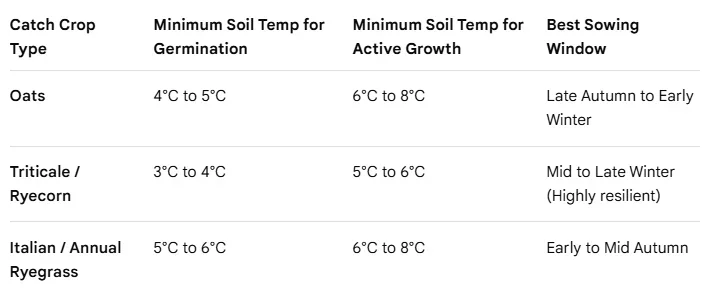
While many winter-hardy species can survive frost, they still require a minimum amount of warmth to wake up and grow. For the most common New Zealand catch crops, the temperature requirements fall into two categories:
Cereals (Oats, Ryecorn, and Triticale)
Cereals are the undisputed kings of the winter catch crop world due to their incredible seedling vigor in cold conditions.
Oats are highly effective at rapid nitrogen uptake but need a bare minimum soil temperature of 4°C to 5°C and rising to reliably germinate. Once established, their growth slows down significantly if temperatures drop below 6°C.
Ryecorn and Triticale are even more cold-tolerant than oats. They can germinate in soil temperatures as low as 3°C and rising, making them the go-to choice for late-fenced winter forage paddocks in colder regions.
Ryegrasses (Italian and Annual)
Ryegrasses provide excellent ground cover and high-quality spring feed, but they are slightly more sensitive to the winter chill than cereals.
Ryegrass requires a minimum soil temperature of 8°C to 10°C and rising for successful germination.
If sown when soil temperatures are dropping below this threshold, emergence will be severely delayed, giving weeds a chance to take over and leaving the soil vulnerable to winter leaching.
What Happens Below 4°C?
When soil temperatures drop below 4°C, most temperate plants hit what scientists call biological zero**.** At this point, metabolic processes ground to a near-halt.
Sowing into soils below 4°C risks:
Seed Mortality: Seeds absorb water but cannot generate the energy to push through the soil crust, making them easy targets for fungal diseases and rot.
Stalled Root Development: Even if the seed manages to sprout, root elongation stops. Without deep roots, the crop cannot reach or "catch" the nitrates leaching down through the soil profile.
Top Tips: Managing Winter Sowing
Measure at the Right Depth and Time: Do not guess the temperature based on the air. Use a soil thermometer poked 5-8cm deep. Take your readings at 9:00 AM, as this provides the most accurate average daily soil temperature.
Watch the Forecast Trend: A single warm afternoon does not mean the soil is ready. Look for a stable or rising temperature trend over three consecutive days before drilling your seed.
Adjust Sowing Rates: If you are sowing on the cusp of the minimum temperature threshold, increase your seeding rate by 10% to 15% to compensate for the lower germination success rate.
Key takeaways
Catch crops can help capture residual nitrogen after winter grazing.
They can reduce nitrate leaching risk from bare, vulnerable paddocks.
They also help protect soil and can produce extra feed.
They commonly fit after brassicas, fodder beet, kale, swedes, summer turnips, and other grazed forage crops.
Earlier sowing usually means better establishment, more nitrogen uptake, and more feed.
Useful options include oats, triticale, ryecorn, Italian ryegrass, and faba beans.
For oats, a practical guide is around 110 to 120 kg/ha at 30 to 40 mm drilling depth.
Planning ahead matters because timing is often the difference between a catch crop working well or underperforming.
Final word
Catch crops are not complicated.
But they are time-sensitive.
If you want them to do the job properly, the main thing is to think ahead, choose the right paddock, and get them in early.
After winter grazing, that can be one of the simplest ways to hold onto nitrogen, reduce loss risk, protect the soil surface, and grow some extra feed before the next stage of the rotation.
On many farms, that is reason enough to take them seriously.
The Bottom Line: To get the ultimate return on your catch crop investment, aim to get your oats or ryegrass in the ground while soil temperatures are still holding above 5°C. Monitor your paddocks, track your regional soil data, and give your winter cover the best possible start!
FAQ’s
What is a catch crop?
A catch crop is a fast-establishing forage crop sown after winter grazing to capture leftover soil nitrogen, protect soil structure, and produce extra feed before the next main pasture or crop goes in.
Why sow a catch crop after winter grazing?
After winter grazing, soils are often left wet, exposed, and carrying unused nitrogen.
A catch crop helps mop up that available nitrogen, reduce the risk of leaching, improve ground cover, and give you extra high-quality feed in the shoulder period.
Which species are best?
The best species depends on your farm system, sowing window, and feed goals.
Oats are a strong option when you want fast bulk feed and good nitrogen capture.
Italian ryegrass can suit farms wanting flexible grazing and quality feed, especially where a slightly longer use period is useful.
Can oats reduce nitrogen leaching?
Yes.
Oats are widely used because they establish quickly, grow aggressively, and take up available nitrogen from the soil profile.
That makes them a useful option for reducing the amount of nitrogen left sitting vulnerable to leaching.
When should catch crops be sown?
As soon as possible after winter grazing.
The earlier you sow, the better your chance of getting rapid establishment, stronger root development, and useful feed before temperatures drop too far or soils turn against you.
Can I direct drill a catch crop?
Yes, in many situations direct drilling can work well.
It can help preserve soil structure, reduce cultivation passes, and get the crop in quickly.
Success depends on soil conditions, residual compaction, seed-to-soil contact, and good grazing management beforehand.
How much feed will a catch crop grow?
Feed yield depends on species, sowing date, soil fertility, moisture, and temperature.
Earlier sowing into good conditions usually gives the best result.
In practical terms, catch crops can produce valuable extra feed, but performance will vary farm to farm and season to season.
What soil temperature is needed?
Catch crops establish best when soil temperatures are still warm enough to support quick germination and early growth.
The exact requirement varies by species, but in general, warmer soils mean faster strike and stronger early performance.
Oats or Italian ryegrass?
If you want quick bulk, strong early growth, and effective nitrogen capture, oats are often the go-to.
If you want a more flexible grazing option with quality feed and a bit more versatility, Italian ryegrass may suit better.
The right choice comes back to your timing, rotation, and feed plan.
Can catch crops help with freshwater regulations?
They can certainly be part of the solution.
Catch crops may help reduce the risk of nitrogen loss by taking up residual soil nitrogen and reducing the time bare soil is exposed after winter grazing.
That can support a more responsible nutrient management approach alongside your wider farm system and compliance plan.