
Weed Control in New Zealand Pastures: Autumn, Winter and Spring Strategies for Healthier, More Productive Pastures

Chemical weed control has its place....But:- Healthy Soil and Dense Pastures Are the Best Weed Control
Most think weed control starts with a chemical spray programme.
In reality, the best weed control starts with soil health and maintaining a thick, dence, competitive pasture sward.
Weeds find it much more difficult to invade strong, healthy pastures, that have been grazed correctly. Weeds establish where there are gaps; Weeds establish in poor soils.
Those gaps are usually caused by:
· Winter pugging
· Summer drought
· Insect damage
· Overgrazing
· Low fertility
· Declining pasture persistence
· Poor soil structure
Weeds are often symptoms rather than the problem itself.
A dense ryegrass and clover pasture intercepts sunlight, captures nutrients efficiently and leaves little opportunity for weed seedlings to establish.
The most profitable weed control programme is one that favors your pasture selction rather than weeds.
Fill the Gaps Before Weeds Do
Bare ground never stays bare.....If productive species don't occupy it, weeds will.
Thistles, ragwort, buttercup and docks are often indicators that pasture density has declined.
Over-sowing or under-sowing with quality pasture species helps restore pasture density and improves long-term weed suppression.
Pasture renewal should be considered part of weed control—not a separate exercise.
Related: Seed Mixes have a look at a few options here - https://www.vernado.co.nz/seeds-mixes
Multi-Species Pastures and Regenerative Systems: Start with a Clean Slate
Multi-species and regenerative pasture systems can deliver significant benefits, including improved soil biology, increased diversity, better drought resilience and reduced reliance on synthetic inputs.
However, one of the biggest mistakes is establishing a multi-species pasture on top of an existing weed problem.
Weed History Matters
Before heading down the regenerative or multi-species path, it pays to understand the weed history of the paddock.
If perennial weeds such as:
· Californian thistle
· Dock
· Ragwort
· Buttercup
· Couch grass
are already present, they will compete aggressively with newly established species and can quickly dominate the pasture.
Likewise, annual weeds such as:
· Winged thistle
· Variegated thistle
· Chickweed
· Twin cress
can rapidly invade if gaps develop.
Multi-Species Pastures Are Dynamic
Unlike traditional ryegrass and white clover pastures, some species within a multi-species mix naturally decline over time.
Species such as:
· Chicory
· Plantain
· Red clover
Often contribute strongly during the first two to four years but may gradually thin out depending on grazing pressure, insect pressure, fertility and moisture conditions.
As these species disappear, gaps can form.
If there is a history of weed pressure, these gaps are often quickly colonised by undesirable species.
Prevention Is Easier Than Cure
The most successful regenerative and multi-species systems usually begin with:
✓ A clean paddock
Control perennial weeds before sowing. Established weeds are much easier to remove before planting than after the pasture is established.
✓ Correct soil fertility
Balanced nutrition and pH encourage desirable species to compete strongly.
✓ Good grazing management
Avoid overgrazing and maintain residuals to protect plant crowns and soil cover.
✓ Oversowing when required
Multi-species systems should be viewed as dynamic rather than permanent. Introducing additional seed species over time helps maintain diversity and fill gaps before weeds take advantage.
✓ Encouraging succession
As some species decline, others should naturally replace them. Having a strong base of ryegrass and clover underneath helps maintain productivity and ground cover.
A Strong Foundation Is Essential
Regenerative farming isn't about allowing weeds to replace productive pasture.
It's about creating a resilient system where desirable species occupy every inch of soil and weeds have little opportunity to establish.
A dense base pasture with a clean weed history gives multi-species systems the greatest chance of success.
Without that foundation, the journey towards regenerative farming can quickly become frustrating and expensive, with weeds filling the spaces left behind as short-term species naturally decline.
Build diversity on top of a healthy, competitive pasture—not on top of a weed problem.
Soil Fertility and Biology Drive Competition
Healthy soils produce an environment for healthy plants.
Maintaining:
· Soil pH
· Phosphorus
· Potassium
· Sulphur
· Nitrogen
· Trace elements
· Biological activity
allows pasture to recover quickly and maintain density.
Strong pastures and healthy soils naturally suppress weeds, the first starting point is usually a comprehensive soil and herbage test.
Combining Weed Sprays with Liquid Nitrogen and Liquid Nitrogen + Sulphur
Many farmers are now combining selective herbicides with liquid nitrogen or liquid nitrogen and sulphur.
More on Liquid Fertiliser here: https://www.vernado.co.nz/our-fertiliser
Benefits include:
One pass instead of two
Reducing application costs and wheel tracks.
Faster pasture recovery
As weeds die, the surrounding grasses receive nutrients, encouraging tillering and faster canopy closure.
Better utilization of sunlight
Rapid regrowth prevents new weed seedlings from establishing.
Improved nutrient use efficiency
Applying nutrients during active growth often gives a stronger response.
Can chemical rates be reduced when adding liquid N?
Some farmers have achieved satisfactory results using lower chemical rates when conditions are ideal.
However, herbicide labels should always be followed. Test first to ensure satisfactory results are achieved. Mixing chemicals can change how they interact with plants and the environment, so consulting with a certified chemical applicator or agricultural advisor is recommended.
The biggest gains usually come from:
· Early intervention.
· Better timing.
· Improved coverage.
· Smaller weeds.
· Faster pasture recovery.
Good timing saves more money than simply increasing chemical rates.
Why Winter and Spring Are the Best Times for Weed Control
Many problem weeds germinate in autumn and winter.
Examples include:
· Nodding thistle
· Scotch thistle
· Winged thistle
· Variegated thistle
· Ragwort
· Dock
· Buttercup
· Twin cress
· Chickweed
Winter control is often easier because:
· Weeds are smaller.
· Plants are actively growing.
· Clover activity is lower.
· Less chemical is often required.
· Pastures have time to recover before spring growth.
Herbicide Timing and Clover Protection
Good weed control should not come at the expense of losing clover.
Clover contributes:
· Nitrogen fixation.
· Feed quality.
· Animal performance.
· Pasture persistence.
Best practice:
✓ Graze before spraying.
✓ Allow fresh regrowth.
✓ Spray actively growing weeds.
✓ Avoid frost and waterlogging.
✓ Target seedlings and small rosettes.
✓ Use stronger chemicals only when necessary.
Large weeds and multi-crown plants often require more aggressive treatments, which can suppress clover for several months.
Complete weed eradication isn't always the most profitable outcome.
Checklist for Successful Weed Control
Before spraying:
✓ Identify the weed correctly.
✓ Understand its lifecycle.
✓ Graze the paddock first.
✓ Ensure weeds are actively growing.
✓ Avoid frosted or stressed plants.
✓ Check rainfall forecasts.
✓ Spray weeds while they are small.
✓ Consider clover protection.
✓ Plan pasture recovery after spraying.
Withholding Periods and Grazing
For optimum control:
Before spraying
· Graze tightly.
· Expose weed rosettes.
· Allow 3-7 days for fresh growth.
After spraying
· Keep stock out for at least the label recommendation.
· It is vital to emphasize that some plants remain toxic even as they wilt. When the plant dies, it can lose its bitter taste—which usually discourages livestock from eating it—but it retains harmful alkaloids. Stock should be excluded from the area until the plants have completely decomposed and are no longer accessible to grazing animals. Refer to regional biosecurity guidelines for specific exclusion timelines
Always follow label recommendations.
Controlling Nodding Thistle
Nodding thistle is one of New Zealand's most damaging weeds.
It thrives where:
· Drought has opened the pasture.
· Winter pugging has occurred.
· Insect damage has weakened the sward.
· Pasture density has declined.
Plants germinate mainly in autumn and winter and are easiest to control as seedlings and small rosettes.
Large plants often develop multiple crowns from a large root system.
Early intervention provides the best results.
Grubbing: For low-density or isolated patches, use a thistle hoe to chop the taproot 2–3 cm beneath the soil surface. Cutting it off right at ground level leaves dormant buds behind, causing the plant to return as a harder-to-kill multi-crown thistle. Aim to lift at least 5 cm of the root if possible.
Strategic Mowing (Topping): Only perform mowing in the summer when the mature thistles have started flowering but before they set seed. Mowing too early (before flowering) triggers the plant to delay its life cycle and develop multiple crowns
Nodding Thistle Crown Weevil: The larvae heavily tunnel into the crown of winter rosettes, weakening or killing the plant before it can bolt.
Nodding Thistle Receptacle Weevil: Destroys the early-season seeds produced in the primary spring flowers.
Nodding Thistle Gall Fly: Attacks the secondary and tertiary flowers later in the summer season to finish off seed production
Sowing Dry-Tolerant Species: Cultivating dense, deep-rooting pasture species that withstand summer droughts prevents the pasture from opening up and creating the bare soil gaps nodding thistle needs to germinate next winter.
Scotch, Winged and Variegated Thistles
These species rapidly colonise bare areas.
Scotch thistle is usually biennial.
Winged and variegated thistles are annuals.
They compete strongly for:
· Light
· Moisture
· Nutrients
Stock often avoid grazing around mature plants, reducing pasture utilisation and livestock production.
Phenoxy Resistant and Multi-Crown Thistles
Large thistles and resistant populations are becoming more common.
When plants become multi-crowned:
· Control becomes harder.
· Repeat applications may be needed.
· Clover suppression increases.
· Spot treatment becomes more economical.
Severe infestations may justify full pasture renewal.
While they share many traits, understanding their minor differences helps optimize your management strategy:
Scotch Thistle (Cirsium vulgare): As a biennial, it spends its first year forming a massive, incredibly spiny rosette. It is highly opportunistic and will rapidly colonize any open ground left by summer drought or winter pugging.
Winged Thistle (Carduus tenuiflorus): A true annual that germinates massively in autumn. It is distinct because it grows in dense, tightly packed clumps rather than isolated plants, completely choking out light from surrounding ryegrass.
Variegated Thistle (Silybum marianum): An annual or winter annual recognizable by the milky-white veins on its wide leaves. This species is particularly dangerous because it can accumulate toxic levels of nitrate, making it a poisoning risk to cattle and sheep if they are forced to graze it under stress.
Height-Discrepancy Wiping: If thistles have bolted above the height of your grass in late spring, use a towed carpet or roller weed wiper.
Chemical Mix: Charge the wiper with a concentrated mix of metsulfuron-methyl or glyphosate. This applies the chemical strictly to the tall thistles, leaving your valuable shorter pasture grasses and clovers completely untouched.
Controlling Ragwort
Ragwort remains one of the most difficult pasture weeds.
Problems include:
· Long-lived seed.
· Root regeneration.
· Multi-crown plants.
· Year-round growth.
· Toxicity to livestock.
Biological control
Natural enemies include:
· Ragwort flea beetle.
· Ragwort moth.
Results are variable.
Avoid mowing mature ragwort
Mowing ragwort can often encourage the plant to develop multiple crowns and become a more resilient perennial
Control is most effective when plants are young.
The Danger Window: After you spray or cut ragwort, the plant wilts and sugars concentrate in the leaves, making it highly palatable to stock.
Safety Rule: You must keep cattle and horses out of treated paddocks until the sprayed ragwort plants have completely rotted down and disappeared. Sheep are more tolerant to the toxin and are often used strategically to graze young rosettes, though prolonged exposure can still cause chronic liver damage.
Organic Weed Control
Research has shown some organic systems do not necessarily have greater weed pressure than conventional farms.
Successful organic systems rely on:
Walk paddocks regularly
Catch problems early.
Never let weeds seed
Repeated removal weakens root reserves.
Mow perennial weeds
Strategic mowing.
Graze multiple species
Sheep and goats often consume weeds cattle avoid.
Rotate stock
Prevent overgrazing.
Prevent seed spread
Clean machinery and avoid contaminated hay and bailage.
Maintain fertility
Healthy plants out-compete weeds, regular soil testing.
Regenerative Weed Control
Regenerative agriculture focuses on fixing the cause rather than the symptom.
Principles include:
· Maintaining soil cover.
· Increasing pasture diversity.
· Improving soil biology.
· Avoiding overgrazing.
· Strategic grazing management.
· Over-sowing damaged areas.
· Encouraging strong root systems.
Healthy, diverse pastures naturally suppress weeds.
Perennial Weeds
Some weeds survive through extensive root systems.
Examples include:
· Californian thistle
· Dock
· Buttercup
· Couch grass
Selective herbicides often suppress top growth but repeated applications may be needed.
In severe infestations, spraying out and re-establishing pasture can provide the greatest return.
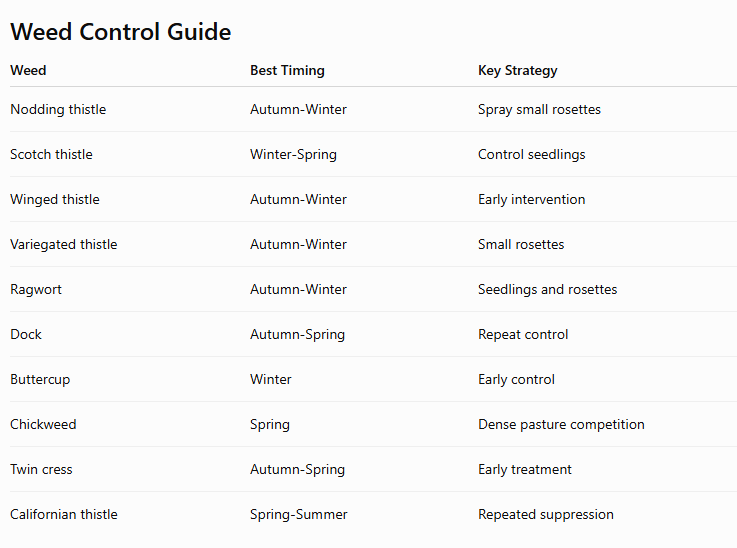
Weed Control Guide
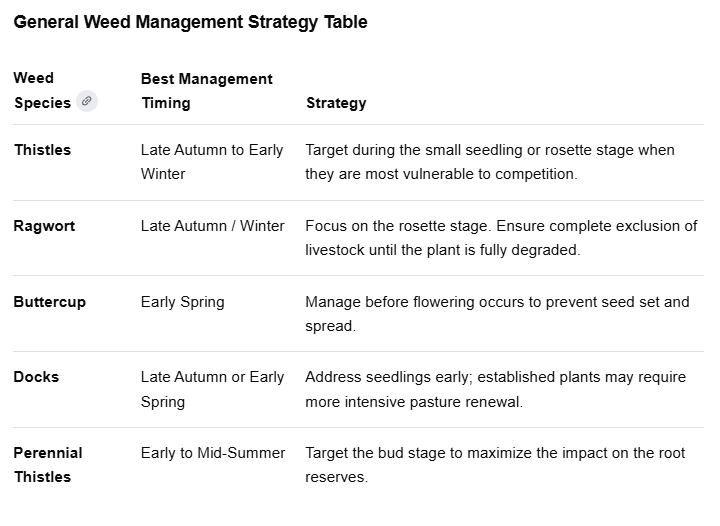
Or this Option:
Frequently Asked Questions:
Why are weeds worse after drought or pugging?
Because gaps allow weed seeds to be established.
When is the best time to spray weeds?
Autumn and winter, when weeds are small and actively growing.
Can I control weeds without chemicals?
Yes. Grazing management, mowing, oversowing and biological control can be highly effective.
Why does ragwort keep returning?
It regenerates from roots and produces long-lived seed.
Why do thistles keep coming back?
They exploit thin pastures and bare soil, and some regenerates from roots
Is killing weeds enough?
No. The objective isn't simply to kill weeds.
The objective is to fix the soil and replace weeds with productive pasture.
New Zealand Pasture Herbicides for weed control: Active Ingredients & Brand Names
MCPA
The foundational tool for winter broadleaf management in established dairy and drystock pastures. It offers highly effective, systemic control against thistles and buttercup.
Target Weeds: Nodding thistle, Scotch thistle, annual buttercup, giant buttercup, dandelions.
NZ Brand Names: Nufarm Agritone® 750, Kenso MCPA 750, Orion MCPA 750, Rainbow & Brown MCPA750.
MCPB
A highly selective phenoxy option designed for ultimate clover safety. It is specifically formulated to treat juvenile broadleaf weeds in freshly sown, young pastures without stalling early clover development.
Target Weeds: Ragwort seedlings, young docks, fathen, wild turnip.
NZ Brand Names: Nufarm MCPB 400, Orion AgriScience Synergy MCPB, Thistrol Plus (MCPB + MCPA blend).
2,4-D Amine
An ultra-low volatile formulation of 2,4-D. It provides a safer alternative to older ester formulations around non-target crops while delivering cleaner, more economical control over early-stage autumn and winter annual seedlings.
Target Weeds: Ragwort seedlings, winged thistle, variegated thistle, chickweed, young docks.
NZ Brand Names: Baton® 800WSG, Sprinter® 700DS.
2,4-D Ester
A fast-acting, high-strength auxinic herbicide that rapidly penetrates thick weed cuticles. It is highly effective for heavy seasonal knockdowns, though it causes noticeable, temporary clover suppression.
Target Weeds: Dense thistle infestations, nodding thistle, variegated thistle rosettes.
NZ Brand Names: Nufarm Relay® Super S.
2,4-DB
The go-to liquid solution for maximizing clover and lucerne safety during early-stage pasture establishment. It allows farmers to clean out competitive weeds before they choke out newly struck seed rows.
Target Weeds: Twin cress, young docks, ragwort seedlings, chickweed.
NZ Brand Names: Pasture Guard 2,4-DB, Cloverlea.
Aminopyralid + Fluroxypyr / Triclopyr
A heavy-duty, highly systemic combination that works down into the root architectures of tough perennial weeds. It is widely relied on across lifestyle blocks and commercial beef units for its comprehensive weed spectrum.
Target Weeds: Established docks, multi-crown ragwort, buttercup, thistles.
NZ Brand Names: Corteva Tordon™ PastureBoss™.
Clopyralid
The premier choice for tackling deep-rooted, clonal, or phenoxy-resistant thistle varieties. Because it strongly suppresses white clover, it is frequently used as a localized spot spray or a tank-mix "spike."
Target Weeds: Californian thistle, multi-crown nodding thistle, Scotch thistle.
NZ Brand Names: Nufarm Archer® 750, Orion Clopyralid 600, Vivendi.
Triclopyr + Picloram
A potent, non-selective chemical combination reserved for woody brush, scrub, or completely overrun perennial pasture environments. It carries long soil residual activity and requires careful grazing withholding periods.
Target Weeds: Mature multi-crown ragwort, old gorse, blackberry, sweet brier.
NZ Brand Names: Conquest®, Arxada Victory Gold (also utilized on sports turf).
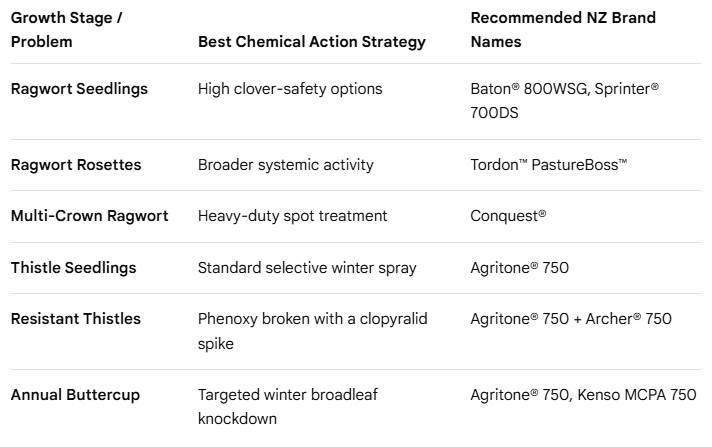
Summary Matrix for Ragwort, Buttercup & Thistle Management
Can Herbicides Be Applied with Liquid Nitrogen?
Many New Zealand farmers now combine selective herbicides with UAN, liquid nitrogen or liquid nitrogen and sulphur.
Potential benefits include:
· One pass instead of two: Reduces tractor hours and fuel burn.
· Faster pasture recovery: Nitrogen immediately feeds the grass as weed competition drops.
· Improved sward density: Promotes rapid tillering to close up bare ground.
· Better utilisation of nutrients: Combined application capitalises on ideal seasonal growth windows.
· Reduced application costs: Maximises contractor efficiency per hectare.
Critical Best Practices for Tank-Mixing:
· Avoid Scorch: Never spray during frosts or hot, high-UV days to prevent ryegrass and clover leaf burn.
· Check Compatibility: Always conduct a physical jar test before mixing products like MCPA or 2,4-D with liquid fertilizer solutions.
· Stick to the Label: While some growers report satisfactory results using lower herbicide rates under ideal conditions, always follow label recommendations. Underdosing could increases the risk of poor weed control and may accelerate herbicide resistance.
Some farmers report satisfactory results using lower herbicide rates under ideal conditions. However, it pays to follow label recommendations and seek professional advice before altering rates.
Final Thoughts
The best weed control programme should start before the spray tank.
Healthy soil, balanced fertility, quality seed, good grazing management and timely nutrition are the foundations of long-term weed control.
Chemical, organic and regenerative approaches all have a place.
But the farms with the lowest weed pressure generally have one thing in common:
Dense, healthy pastures with no gaps. Because weeds exploit weakness. Strong pastures don't give them the opportunity.
Talk to us today about your pasture health today
0805 733 343
Sales@vernado.co.nz